
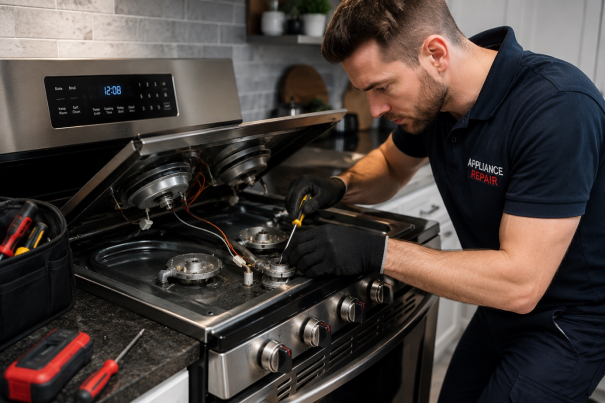
A stove burner that suddenly stops working can quickly disrupt your daily routine. Before assuming the appliance needs to be replaced, there are several simple checks that may help identify the cause. Some issues are minor and easy to fix, while others require professional attention.
Check the Power Supply
For an electric stove, begin by confirming that the appliance is receiving power. Check whether the stove display, oven light, or other burners are working. If the entire appliance is unresponsive, inspect the circuit breaker to see whether it has tripped.
Resetting the breaker may restore power, but if it trips again, avoid repeatedly switching it back on. This could indicate an electrical fault that should be inspected by a qualified technician.
Inspect the Burner Connection
On stoves with removable coil burners, the burner may not be properly connected to its socket. Allow the appliance to cool completely, then remove the burner and carefully reinstall it.
Look for signs of corrosion, burning, cracks, or loose connections. A damaged coil or socket can prevent the burner from heating and may need to be replaced.
Examine the Control Knob
A loose or broken control knob can make it seem as though the burner is not responding. Remove the knob and inspect the shaft underneath. If the knob is cracked or no longer grips the shaft properly, replacing it may solve the problem.
The issue may also come from the internal burner switch, especially if the knob turns normally but the burner remains cold.
Check a Gas Burner for Blockages
For a gas stove, food particles, grease, or moisture may block the burner ports. Make sure the stove is off and cool before removing the burner cap.
Clean the burner openings gently with a soft brush or a thin, non-metallic tool. Ensure that the burner cap is completely dry and positioned correctly before testing it again.
Listen for the Ignition Spark
When turning on a gas burner, listen for a clicking sound and look for a visible spark. No clicking may indicate a problem with the ignition switch, wiring, or spark module.
If you smell gas without seeing a flame, turn the burner off immediately, ventilate the room, and avoid using electrical switches or open flames.
Know When to Call a Technician
Stop troubleshooting if you notice damaged wiring, repeated breaker trips, gas odours, sparks, or burned components. Professional Stove Repair is the safest option when the cause involves electrical parts, gas connections, or internal controls.
Checking the power, burner connection, control knob, and ignition system can help identify common problems. However, safety should always come first when dealing with gas or electricity.





Leave a Reply